


Classification, Properties and Application Scenarios of Mainstream Grate Bar Materials
-1140x380.png "Classification, Properties and Application Scenarios of Mainstream Grate Bar Materials")
By Alex Hu - 01/08/2026 - 0 comments
Core Performance Requirements for Grate Bars
.png)
Grate bars must feature high temperature resistance, thermal shock resistance, wear resistance, oxidation resistance and slag corrosion resistance. Ranked below in accordance with the most common applications in industrial boilers:
I. Ordinary Cast Iron Series (First Choice for Small Atmospheric Coal-Fired Boilers at Low Temperatures, Best Cost Performance)
1. Grey Cast Iron (HT150 / HT200)
Characteristics: Lowest production cost, easy casting, excellent thermal conductivity and self-lubricating wear resistance; high brittleness and poor heat resistance.
Long-term Service Temperature: ≤650~700°C
Drawbacks: Prone to oxidative scaling once temperature exceeds 700°C, and susceptible to cracking under thermal shock from cold water, resulting in short service life.
Applications: Household heating stoves, 1–4 ton small chain grate boilers, low-temperature biomass boilers, passive grate bars (non-stressed positions).
2. Malleable Cast Iron (KTH350)
Characteristics: Far superior toughness compared to grey cast iron, resistant to brittle fracture and minor impacts.
Applications: Driving grate bars of chain grate boilers (positions bearing transmission force and subjected to reciprocating friction with hinge pins); standard fitting for old small-tonnage boilers.
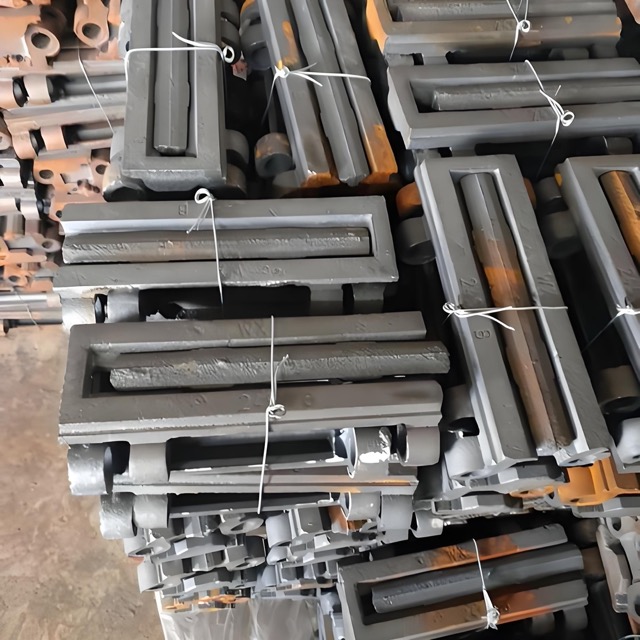
3. Ductile Cast Iron (QT450 / QT500)
With spherical graphite structure, it boasts higher strength, toughness and thermal fatigue resistance than grey cast iron, accompanied by moderately improved heat resistance.
Applications: Medium-load reciprocating grates, biomass combustion furnaces; positioned between ordinary cast iron and heat-resistant cast iron in performance.
II. Alloy Heat-Resistant Cast Iron (Most Widely Used Mainstream Material for Industrial Coal-Fired & Biomass Boilers)
1. High-Silicon Heat-Resistant Cast Iron (RTSi5, commonly known as Silicon 5) 【Most extensively used on the market】
National Standard Grade: RTSi5 (silicon content: 4.5%~5.5%)
Advantages: Forms a dense silicon dioxide protective film on the surface under high temperatures with outstanding oxidation resistance; moderately priced.
Long-term Service Temperature: 750~850°C
Applications: Chain grates, reciprocating grates, biomass boilers and most industrial coal-fired boilers; standard material for straight grates, four-claw grates and fish-scale grates.
2. Chromium-Based Heat-Resistant Cast Iron (RTCr1, RTCr2, RTCr16)
RTCr1 / RTCr2: Low-chromium cast iron, slightly better heat resistance than Silicon 5 and superior sulfur corrosion resistance, ideal for burning high-sulfur coal.
RTCr16 (High-Chromium Heat-Resistant Cast Iron): Chromium content 15%~18%, withstands temperatures above 900°C, featuring top-tier oxidation and corrosion resistance.
Applications: High-temperature combustion zones, waste incinerators, auxiliary grates of circulating fluidized beds, and working conditions firing inferior high-sulfur fuels.
3. Aluminum-Based Heat-Resistant Cast Iron (RTAl)
Excellent high-temperature resistance yet high brittleness and complicated casting process; mainly applied to small high-temperature furnaces with low market popularity.
III. Cast Steel Materials (For Heavy-Duty, High-Temperature and Reciprocating Motion Working Conditions)
1. Ordinary Carbon Cast Steel (ZG230-450)
Characteristics: Excellent toughness and impact resistance with low fracture risk; average wear resistance, prone to oxidation and deformation under high temperatures.
Applications: Movable plates of reciprocating grates, heavy-duty beam grates, flipping grates for waste incinerators (subjected to repeated pushing and pulling loads).
2. Heat-Resistant Alloy Cast Steel (High-Chromium Cast Steel, 1Cr18Ni9 Stainless Cast Steel)
Withstands temperatures of 950~1100°C, delivering the strongest resistance to acid-alkali corrosion, flue gas erosion and abrasive slag scouring.
Drawback: Highest material cost.
Applications: Municipal solid waste incinerators, hazardous waste incinerators, grate bars for large high-temperature power station boilers.
IV. Niche Special Materials
High-Chromium White Wear-Resistant Cast Iron: Prioritizes wear resistance with mediocre heat resistance, mostly used as wear liners on the side walls of grates.
Vermicular Graphite Cast Iron: Balances thermal conductivity and mechanical strength, rarely adopted for main grate bar bodies.
Tags: Grate Bar Materials